I’m Adam Widdison, author of The Expert Clinician. My work explores how healthcare professionals (HCPs) think—and, just as importantly, how we can strengthen that thinking in the demanding reality of modern practice.
In my previous blog, Empathy: “I Want to Know How You Feel”, I explored how understanding a patient’s thoughts, feelings, and experiences can help build meaningful clinical relationships.
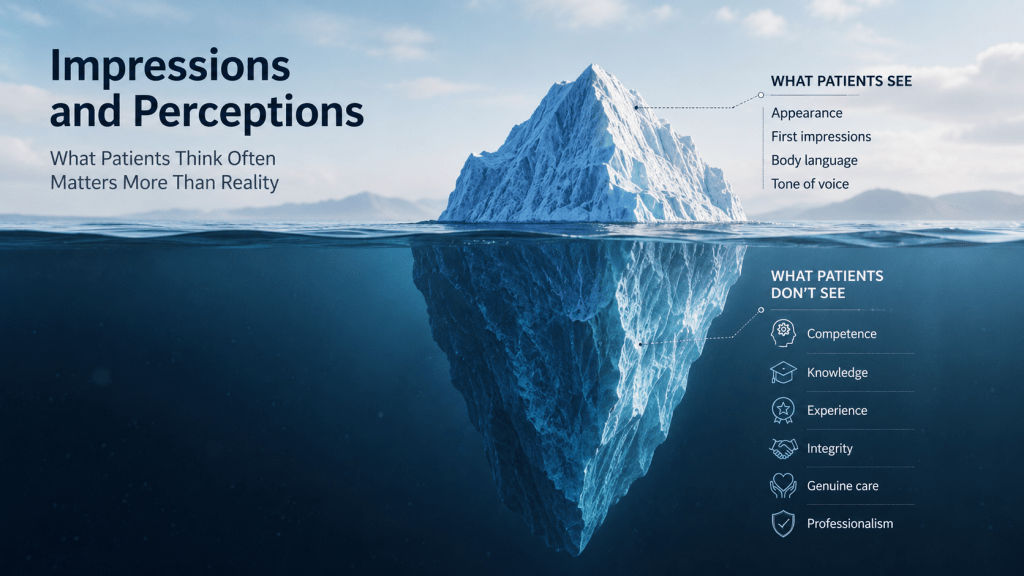
In this post, I want to reflect on another important—yet often overlooked—aspect of consultations: the impressions we convey and the perceptions we create.
Patients form opinions based on their experience of us, not necessarily on objective reality. That may feel uncomfortable, but it is a deeply human truth. In healthcare, perception often becomes reality.
When Perception Becomes Reality
A colleague once shared a telling story.
A woman who was admitted to the hospital after suffering a stroke had consulted her GP several weeks earlier because of persistent headaches. The GP correctly recognised poorly controlled hypertension, adjusted her medication, and provided clear, evidence-based advice.
Technically, everything had been done correctly. The diagnosis was accurate, the reasoning was sound, and the treatment was appropriate.
But the patient never took the medication.
When asked why, her response was striking:
“She was talking to me as if she were reading from a textbook. She didn’t listen to anything I said and didn’t seem to care about me. I didn’t feel I mattered to her.”
The GP had not made a clinical error, yet the impression created during the consultation undermined the entire encounter—with serious consequences for the patient.
The consultation is not only about what we know. It is also about how patients experience that knowledge, professionalism, and care.
- You may be exceptionally knowledgeable and skilled — but does the patient feel confident in your abilities?
- You may be trustworthy — but does the patient feel they can trust you?
- You may be highly respected by colleagues — but do patients respect you?
- You may genuinely care — but does the patient feel cared for?
In many situations, perception becomes reality.
The Halo Effect
We often make rapid judgments based on limited information.
An HCP who appears calm, organised, confident, and attentive is more likely to be perceived as competent, trustworthy, and caring.
Conversely, an HCP who appears rushed, distracted, disorganised, or dismissive may struggle to inspire confidence, regardless of their actual expertise.
Psychologists refer to this as the halo effect: a positive first impression influences how people view everything else about us.
The reverse can also occur. A single negative impression may colour the entire consultation—a phenomenon sometimes called the horns effect.
Shaping Perceptions Throughout the Consultation
Perceptions influence every stage of the consultation.
Every patient arrives with their own experiences, beliefs, fears, expectations, and assumptions.
Throughout the consultation, they are continually asking themselves:
- Can I trust this person?
- Do they care about me?
- Will they help me?
- Do I believe in them?
First Impressions Can Be Lasting
From the moment a patient arrives, they begin forming opinions.
- Does the clinic seem well-organised?
- Are they showing interest in me by being present and engaged?
- Do I like them?
- Do I trust them?
Simple actions matter enormously:
- A well-organised consultation.
- A warm and friendly greeting.
- A proper introduction.
- Good eye contact.
- A sincere smile.
- Focused attention.
These seemingly small moments often shape the entire consultation (A Good Start Matters: the Art of the Clinical Opening).
HCPs can also be swayed by first impressions. The initial perceptions we form about patients can influence how we listen, interpret data, and make decisions.
Recognising this is an important aspect of professional self-awareness.
Build Connection
Patients quickly notice whether we see them simply as another case or as a person living with an illness.
Taking time to learn about the individual—their life, values, concerns, and circumstances—demonstrates respect and genuine interest (Connection: the Secret to a Successful Consultation)
This is not simply small talk. It helps build rapport, strengthens communication, and often provides clinically relevant information.
Empathy transforms a routine consultation into one where patients feel seen, understood, and supported (Empathy: “I want to know how you feel”).
Understand the Bigger Picture
One of the most valuable steps in any consultation is to understand the patient beyond the presenting issue.
When patients have ongoing medical conditions and complex medical histories, an early review serves as an important safety net.
Done well, it achieves far more than information gathering: it reassures patients that their lived experience matters, builds confidence in the HCP, and provides essential context for diagnosis and management.
Learn About the Problem
The way we explore a patient’s problem also shapes their perception of us.
Medical knowledge determines which questions we ask, how we listen determines what patients think of us.
- Are our questions relevant and thoughtful?
- Do we listen carefully?
- Do we demonstrate understanding and concern?
Patients understand that diagnosis is often a balance of probabilities. Their confidence in that diagnosis is strongly influenced by their confidence in the person delivering it.
The Examination
Physical examination places patients in a vulnerable position.
Professionalism, sensitivity, clear explanations, and asking permission show respect for their autonomy and dignity, and influence how patients experience the examination and how they perceive the clinician conducting it.
Even a technically excellent examination can create a poor impression if it is performed insensitively.
Close Well
Patients often remember the end of the consultation most clearly.
A clear explanation, practical plan, and opportunity to ask questions leave patients feeling informed, included, supported, and confident about the next steps.
Common Pitfalls
Good intentions do not always create positive perceptions.
Sometimes the issue is not what we intend, but how our actions are experienced.
Assumptions Create Blind Spots
In busy healthcare environments, there is a natural tendency to make assumptions.
Although assumptions can feel efficient, they often create blind spots.
We may assume we understand what a patient means, what they want, what worries them, or what outcome they hope for. Misunderstandings, errors, and missed opportunities frequently arise when we assume rather than ask.
Checking rather than assuming demonstrates curiosity, respect, and professionalism.
Bias: The Hidden Influence
Bias often operates beneath our awareness.
We may unintentionally stereotype patients, favour people we identify with, or seek information that confirms our initial impressions.
Left unchecked, bias can influence communication, clinical reasoning, decision-making, and ultimately patient care.
Developing self-awareness helps us recognise these tendencies before they affect outcomes.
When Communication Creates Barriers
Healthcare professionals can unintentionally damage perceptions through behaviours such as:
- Appearing rushed or distracted.
- Interrupting patients.
- Focusing more on the computer than the person.
- Using excessive jargon.
- Failing to explain reasoning.
- Forgetting important details.
Even highly competent clinicians may appear uncaring if communication is poor.
Why This Matters
Patient perceptions influence almost every aspect of care:
- Communication.
- Confidence.
- Trust.
- Adherence.
- Satisfaction.
- Long-term engagement.
Patients who feel confident in their clinician are more likely to participate actively in their care.
Those who develop negative impressions may become guarded, sceptical, or disengaged.
The consequences can extend far beyond a single consultation.
Take-Home Message
There is an old saying in medicine:
“Patients don’t care how much you know until they know how much you care.”
This is not an argument against knowledge or expertise. It is a reminder that clinical excellence alone is not always enough.
Experience means nothing if you give the wrong impression.
Patients feel the consultation before they analyse it.
Those feelings—fair or not, accurate or not—shape everything that follows.
We cannot fully control how we are perceived, but we can be intentional about how we present ourselves, what we say, how we listen, and how we make people feel.
In clinical practice, that is never a small thing.
In my next blog, ‘Confidence, Trust and Respect: The Three Pillars of a Successful Consultation’, I’ll explore how impressions and perceptions develop into something even more powerful: confidence, trust, and respect.
Medical knowledge and technical expertise remain essential, but on their own, they are rarely sufficient. Healthcare professionals also need the ability to instil confidence, earn trust, and command respect.
Small acts of kindness and genuine interest leave a lasting impact and significantly strengthen relationships. After all, patients rarely remember every detail of what we say, but they almost always remember how we made them feel.
If you are a healthcare professional seeking to navigate patient consultations in a person-centred, meaningful, and compassionate manner, please share my latest blog 👇 with your colleagues.
Confidence, Trust and Respect: The Three Pillars of a Successful Consultation
These ideas are explored further in The Expert Clinician: Bridging the Clinical Divide. If you’re interested in developing a more adaptive, patient-centred approach, you can read more here:
 The Expert Clinician
Thoughts? Join the conversation…..