I’m Adam Widdison, author of The Expert Clinician. My work explores how we can sharpen our thinking and performance in the demanding realities of modern practice.
In my earlier blog post, ‘A Good Start Matters: The Art of the Clinical Opening‘, I highlighted the importance of treating patients as people with a problem — not merely as a “presenting complaint”. In the next series of blog posts, I explored the skills needed to build a working relationship — the human side of the consultation.
Connection: The Secret to a Successful Consultation
Empathy: “I Want to Know What You Feel”
Impressions and Perceptions: What Patients Think Often Matters More Than Reality
Confidence, Trust and Respect: The Three Pillars of Every Successful Consultation
Managing Issues, Conflicts, Barriers and Concerns: How to Get a Consultation Back on Track
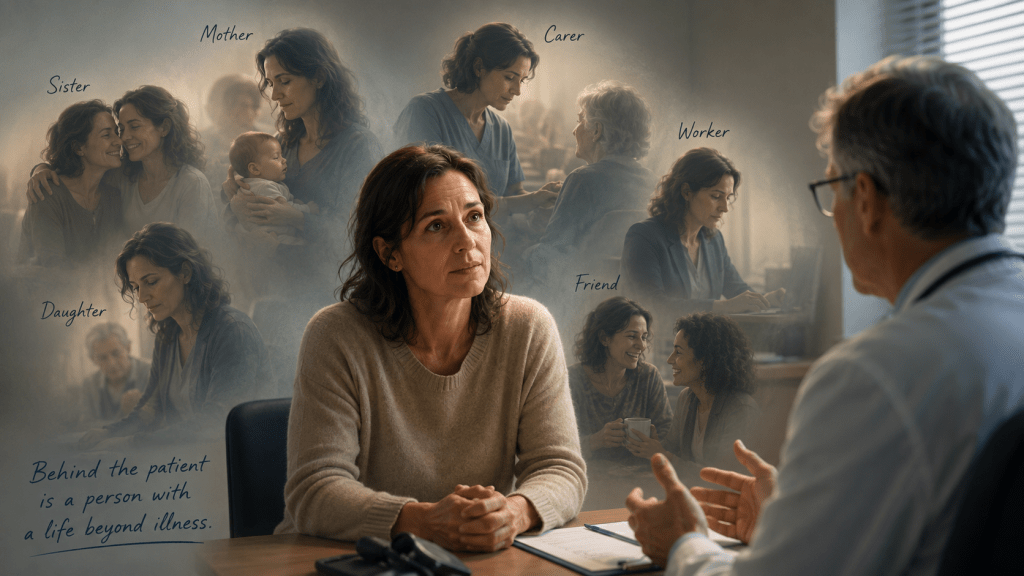
Understanding that patients are real people with challenges is key to delivering compassionate care.
In this and future blog posts, we will explore the skills and methods necessary to understand the patient as a person, which is key to truly knowing them and offering compassionate care.
Why Learn About the Patient as a Person?
It’s a fair question. After all, they are coming to us for help with a problem, not to share their private lives.
Every patient is an individual with a unique life, relationships, responsibilities, beliefs, fears, hopes, expectations, experiences and circumstances. Recognising this is not optional; it is fundamental to compassionate, effective healthcare.
It helps us:
- Build rapport and trust.
- Respect their individuality, autonomy, and dignity.
- Help patients relax.
- Encourage open communication.
- Understand the real impact of illness.
- Establish a diagnosis
- Customise management.
- Share decision-making.
- Improve adherence and outcomes.
The consultation is often the best — and sometimes the only — opportunity to achieve this within a care pathway that may include multiple investigations and treatments.
Understanding the Person Beyond the Checklist
Traditionally, clinicians gather information under the heading of “Personal and Social History.” Questions about occupation, smoking, alcohol use, relationships, and lifestyle often become routine checklist items.
True understanding goes well beyond checklists.
The goal isn’t simply to collect data, but to gain insights that enhance our understanding of the patient and improve care.
Every piece of information may be clinically significant:
- Demographic details shape diagnostic probability.
- Impressions can signpost underlying issues.
- Certain occupations and habits are direct risk factors.
- Lifestyle provides insight into functional performance.
- Personal opinions influence choice and compliance.
As our knowledge of the clinical issue grows, we can ask specific questions about the patient and integrate them smoothly with problem-related details.
This approach contextualises the illness, potentially refines the differential diagnosis, and strengthens the management plan.
Timing Matters
For most patients, learning personal information is limited to the introductory conversation.
The goals are simple:
- Build rapport.
- Create a human connection.
- Help them feel comfortable.
- Demonstrate interest and respect.
The discussion then naturally shifts to the clinical issue.
Later, especially when prioritising the differential diagnosis or discussing management, obtaining more detailed personal information may be necessary.
For some patients, the first few minutes can profoundly change the course of the consultation. Signs such as anxiety, fear, distress, withdrawal, conflict, mistrust, or communication difficulties may demand immediate action.
In these cases, gaining insight into the person often becomes essential to understanding their situation.
First Impressions Can Reveal Important Clues
Even brief introductions and initial impressions can provide valuable insights:
Appearance may reveal:
- Clothing that is too large suggests significant recent weight loss.
- Frailty, obesity, or anorexia.
- Signs of illness, such as jaundice, fever, cachexia, or rheumatoid hands.
- Mobility problems, neurological impairment, or physical disability.
Voice and speech may reveal:
- Slurred speech – a stroke?
- Speech loss – laryngitis?
- Hoarseness – hypothyroidism or vocal cord cancer?
- Breathy voice – vocal cord paralysis?
- Monotone speech – Parkinson’s disease?
Conversation may reveal:
- Cognitive impairment.
- Memory difficulties.
- Poor concentration.
- Anxiety.
- Depression.
- Confusion.
These observations are often the first clues that help direct further questioning.
Demographic Information: Don’t Ignore the Obvious
Some of the most useful information is often the simplest.
Age, sex, gender, and ethnicity all influence clinical probability and management.
Examples include:
- Severe loin-to-groin pain may be ureteric colic in a young patient, but an aortic aneurysm needs to be excluded in an older patient.
- Pelvic inflammatory disease occurs only in females, and testicular cancer in males.
- The incidence of sickle cell anaemia and prostate cancer is higher in Black and African/Caribbean communities.
Personal Information Can Inform Diagnosis
Details about the patient’s life, such as occupation, physical activities, or hobbies, can provide valuable diagnostic insights.
For example:
- Pneumoconiosis in miners.
- Pollution may lead to asthma.
- Relationships may affect emotional well-being.
- Discussing a patient’s sex life when they present with a sexually transmitted disease.
- Common risk factors include alcohol consumption, smoking, drug use, and diet.
Sometimes the most important clues emerge when something simply “doesn’t feel right”: our own thoughts and feelings may suggest hidden concerns such as neglect, abuse, coercion, or domestic violence.
These possibilities require sensitive exploration because the opportunity to identify them may not arise again.
Management Should Be Personal
Management is always a choice — for the clinician (selecting options) and for the patient (accepting them).
Most patients accept the recommended management. A minority have specific needs or personal opinions that shape what they want or hope for.
Understanding the individual may affect the diagnosis, but it will always influence the management.
Effective management integrates:
- Information about the problem.
- Examination findings.
- Co-morbidity
…. with information about the person.
Patients differ in their circumstances, lifestyles, beliefs, priorities, fears, and preferences. When discussing management options, it may be important to explore:
- Hopes, fears, and expectations.
- Personal values.
- Family circumstances.
- Work commitments.
- Cultural or religious beliefs.
- Lifestyle.
Management plans that align with the patient’s life and preferences are more likely to be accepted, followed, and successful.
Take-Home Message
Learning about the patient as a person is far more than a social exercise:
- It gives the problem a human identity.
- It improves diagnostic reasoning.
- It personalises management.
- It supports shared decision-making.
…. and ultimately leads to better outcomes.
For the patient,
- It demonstrates respect for their autonomy.
- Builds rapport.
- Strengthens trust.
- Creates a stronger therapeutic relationship.
…. with benefits that extend throughout the care pathway.
Even small acts of genuine interest can make patients feel heard, valued, safe, and supported.
I’d be interested in hearing your thoughts.
Have you experienced the difference it makes when an HCP truly sees you as a person?
In my next series of posts, I explore demographic characteristics: often overlooked yet silently influential in healthcare.
In my first post in this series, I discuss why age isn’t merely a demographic detail—it’s one of the most powerful clues in clinical practice. It shapes diagnostic probability, informs decision-making, and provides essential context for understanding the patient.
Click the link to read my next post 👉
The Personal Side of Demography: Age Beyond the Statistics
These ideas are explored further in The Expert Clinician: Bridging the Clinical Divide. If you’re interested in developing a more adaptive, patient-centred approach, you can read more here:

Thoughts? Join the conversation…..